
Real time, no excuses
The audio callback does not allocate, take locks, perform I/O or panic. Everything else happens outside it.

A generative instrument written in Rust: layers, seeds and evolution with a sonic identity of its own.
Every stage ends at a verifiable gate. If the sound does not convince, the engine is fixed before features are added. The first stage is specified in OpenSpec; the rest is sequence, not promise.
GateRevisión de arquitectura y specs
001Workspace, límites y CIGateTres renders de referencia y 30 min sin glitches
002Fundación de audio003Síntesis de voz004Sistema de parámetros005Espacio y carácter006Documento de patchGatePieza de 10 minutos con identidad
007Reloj y scheduler008Generadores I009Generadores II010Evolución011Composición y escenasGateIntención musical a patch reversible
012API de agente013Transacciones014Deshacer y rehacer015Adaptador MCPGatePlugin validado en hosts objetivo
016Plugin VST3 / CLAP017MIDI018Performance019PresetsReal status as of 22 November 2026. Zero audio code written: the first task is the workspace.
Six decisions that separate a generative system from a synthesizer with a randomize button.
The audio callback does not allocate, take locks, perform I/O or panic. Everything else happens outside it.
Same seed, same state, same audio. Offline renders are compared by hash, not by ear.
The generative engine emits musical events, not samples. It has state, relationships and a change budget so identity survives.
The domain knows nothing about audio, UI or language models. Infrastructure implements ports, never the reverse.
It inspects, proposes, validates, auditions and reverts. It never mutates live state on its own.
Standalone first; plugin later. The same runtime, without a second hidden architecture.
Sound is not written note by note. It emerges from repeating layers, inherited seeds and rules that limit how much a piece may change before it stops being itself.
Each voice is a lamella: oscillator, filter, envelope. Timbre appears in how they overlap, not in any one of them alone.
One seed per generator, derived from a master. The same seed returns the same piece; changing it is a decision, not an accident.
Evolution has a change limit per bar and a memory of the motif. Without a budget, chance erases identity.
No audio yet. The first M1 gate requires three reference renders; when they exist, this section will play them.
Clean Architecture, with one explicit exception: real-time audio is not a use case. The control plane is separated from the data plane, and that boundary is designed as its own contract.
Presentation → Application → Domain. Dependencies point downward.
The domain imports nothing from outside. When an outer layer is needed, the dependency is inverted.
See the dependency graph ↗There is no binary and no real capture yet. These are concept mockups of the visual direction: they exist to discuss hierarchy and density, not to claim the app ships.
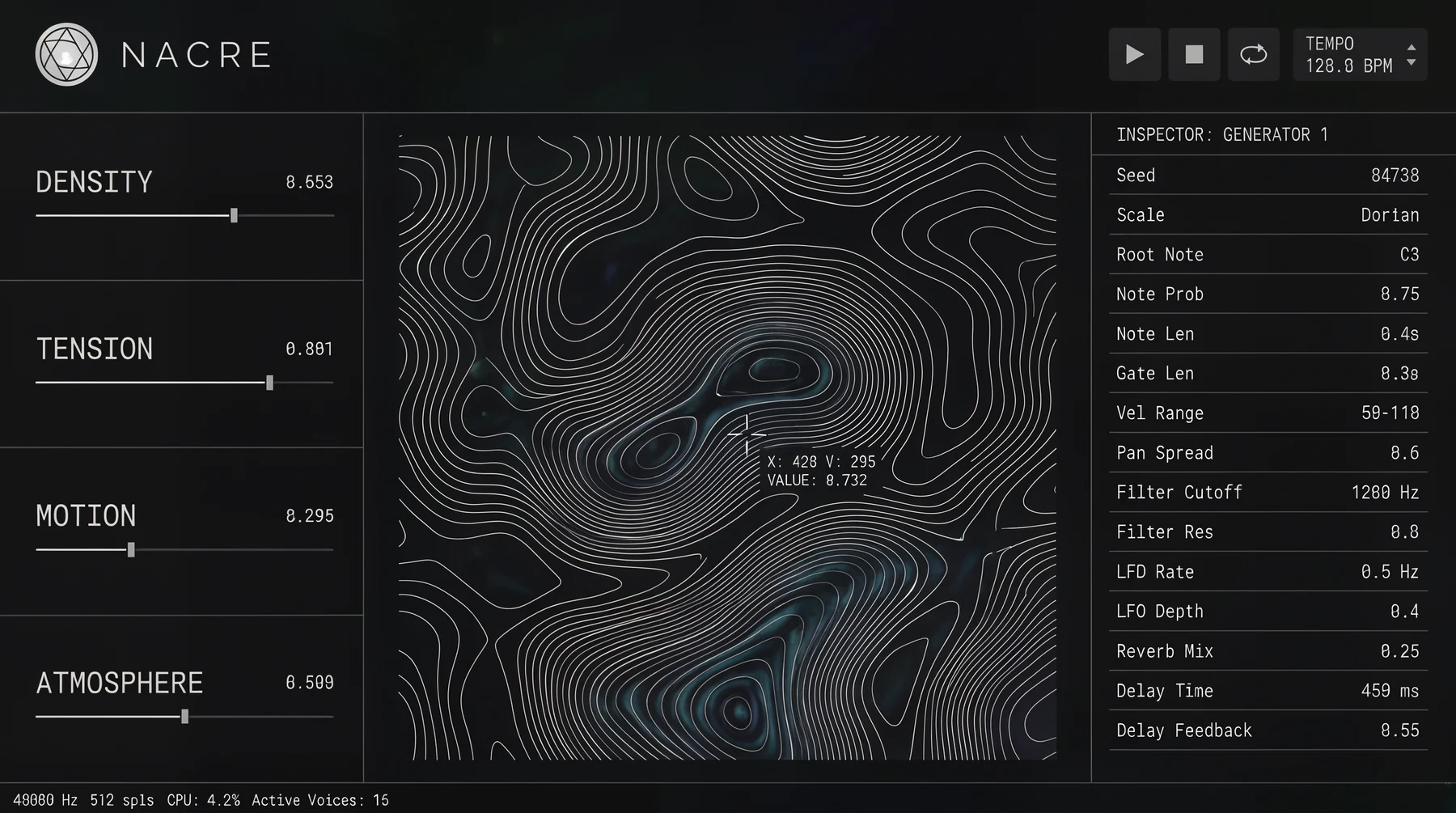
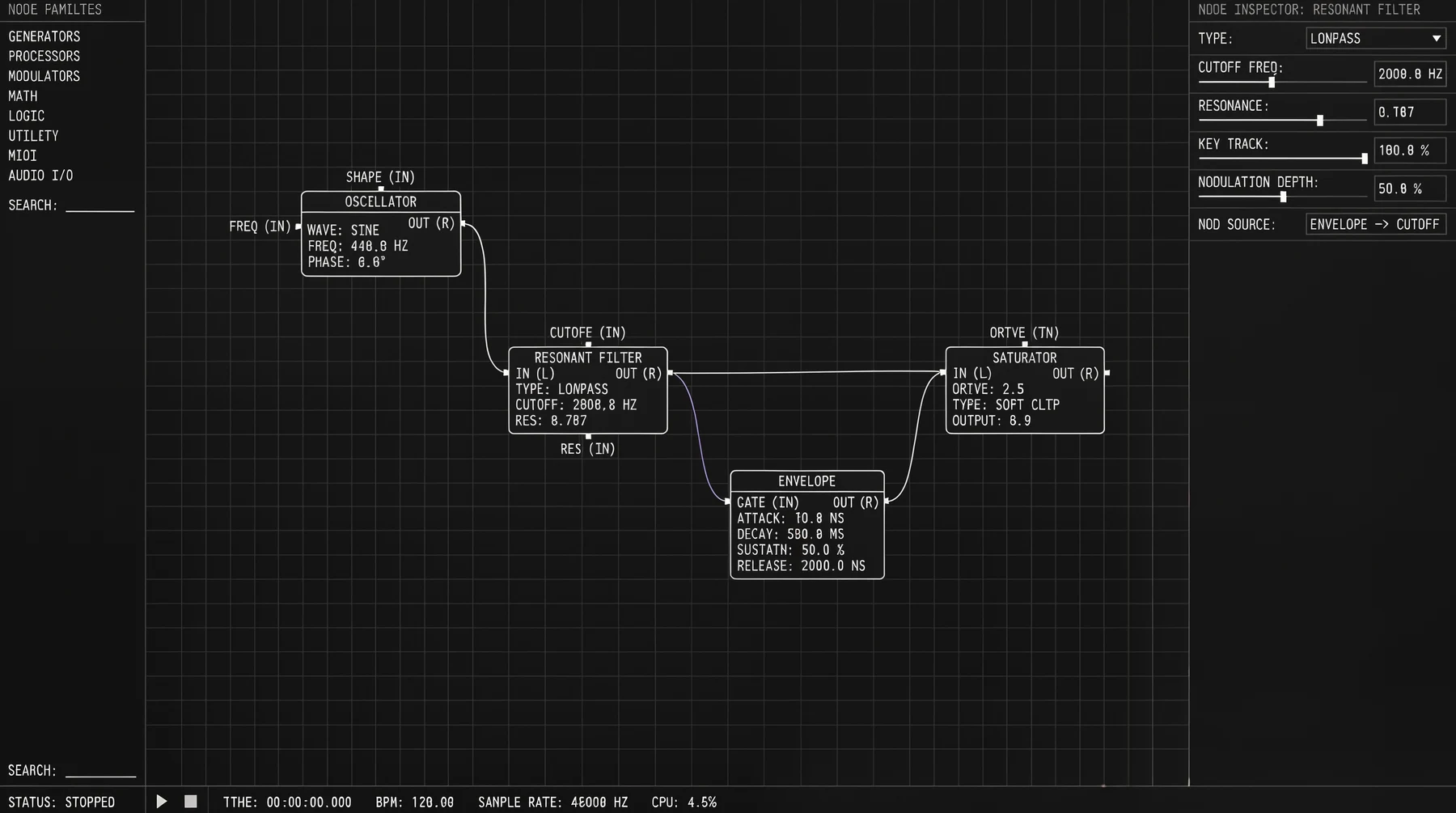
Every behaviour is written as an OpenSpec requirement with verifiable scenarios. If the implementation changes without changing what is observable, the spec does not move.
The audio callback must complete its work without allocating memory, acquiring locks, performing I/O, compiling the graph or panicking, with bounded cost per block.
If real-time audio, generative composition or agents that do not corrupt state interest you, the repository is open and the roadmap can be audited.